Delivery
On-Campus
Become an Innovator in Public Health
The Master of Public Health (MPH) prepares you to make a positive impact on the health and wellness of people in your community and across the globe. In this program, you learn to apply evidence-based principles of public health within a variety of professional settings. In addition to learning core principles, you develop specialized skills in one of three concentrations: Community Health Practice (CHPR), Epidemiology (EPID), or Health Policy (HPOL).
Find out more about graduate education at UNC Charlotte by requesting information and attending an upcoming information session.
Your future is calling. Embrace this opportunity to advance your academic journey by starting your application today.
At Charlotte, our MPH students come from a wide variety of backgrounds which transform our classrooms into remarkable learning environments. If you're looking for an accredited program that is invested in your development as a public health practitioner, where your instructors know your name, and there are opportunities for personal and professional growth, we are the right program for you.
Check out the official catalog for information on specific degree requirements, course progressions, curriculum and more.
| Applicant types | fall admissions | spring admissions |
|---|---|---|
| International Students | N/A | September 1 |
| Priority Decision | January 15 | October 1 |
| Regular Decision | April 15 | November 15 |
For fall term admission, international students should observe the priority and regular decision deadlines as stated
Applications submitted after the MPH program regular decision deadline, and prior to the university application deadline, will be periodically reviewed, subject to space limitations. It is recommended that applicants applying after the regular decision deadline should reach out to the program via email (mphprogram@charlotte.edu) to determine if applications are still being accepted by the program.
NOTE: University scholarships and grants are only available in the Fall semester. In order to qualify, applications should be submitted by the priority deadline.
The UNC Charlotte MPH Program does not conduct summer admissions.
April 15th is the deadline for admitted students to submit their intention to enroll for the Fall semester. UNC Charlotte does not require a deposit or payment at that time, and there is no penalty if you change your mind later. However, offers of funding from the university must be accepted no later than April 15th. Intent to enroll can be submitted in The Graduate School application portal.
Applicants must apply online through Graduate Admissions and upload supporting materials when submitting the online application. Applicants are expected to use The Graduate School application portal to track the progress of their program application and requirements received and/or still needed.
The MPH program follows the basic application requirements of The Graduate School. Please note that our Statement of Purpose and the 3 letters of recommendation have requirements specific to the MPH program. Applicants are expected to reflect these requirements in their submitted materials.
Competitive applicants to the program typically have an undergraduate GPA above 3.0, are responsive to the requirements of the personal statement and have strong letters of recommendation.
The MPH Program no longer requires GRE scores.
In addition to the general requirements for master’s students by The Graduate School, applicants to the MPH program should submit:
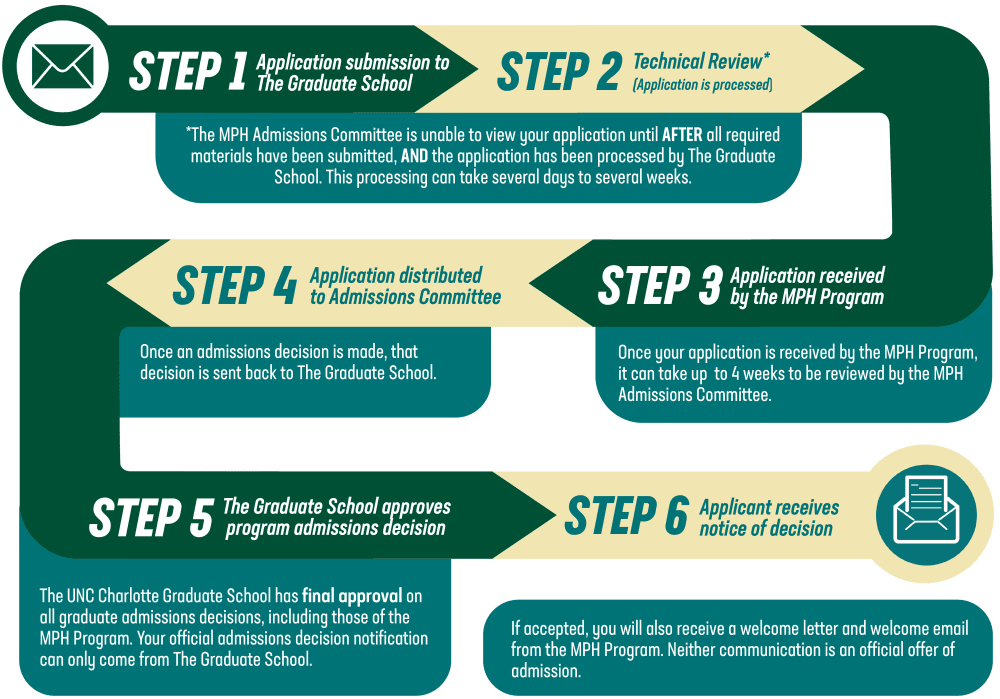
Admissions decisions are made by the MPH Admissions Committee. The Committee only review complete application files, including all required supplemental documents, after The Graduate School’s technical review. Their decisions are final; however, The Graduate School does allow specific decision appeals.
Applications are holistically reviewed which means the MPH Admissions Committee considers the “whole” applicant. Applicants are assessed on the strength of the applicant’s experiences and attributes as well as their academic performance. While GPA is important, the committee is especially concerned with the quality of the statement of purpose and letters of recommendation. The number of students admitted each semester is based on the resources available to the program.
Please check in with the program director if you will submit to the MPH program after the stated deadlines to make sure the program is still accepting applications.
The official mode of communication between the university and applicants is email. You will be notified via email when your admission decision has been made. Your official acceptance letter will come from The Graduate School. You will also receive a welcome letter from the MPH Program.
Important information and resources for admitted students are available on The Center for Graduate Life and Learning Graduate Community page and the MPH program’s Admitted Student Resources page.
Per The Graduate School Deferment Policy, your application and offer of admission is only valid for the specific year and term for which you applied.
Course Courses (15 credit hours)
Applied Learning Expereince (3 credit hours)
Elective Courses (9 credit hours)
MPH students are required to take 2 elective courses with the HLTH prefix and 1 interprofessional elective course outside the department. MPH students enrolled in a Graduate Certificate program (e.g., Emergency Management, Gerontology, or Health Informatics and Analytics) by the end of their first year, may be eligible to substitute some of their certificate credit hours for their MPH elective credit hours. Please consult the MPH Program Director for further details.
Select a course from one of the MPH concentrations outside of the one in which the student is enrolled OR one of the following:
Select a second course from the Cross-Cutting Elective courses OR one of the following:
Complete one master’s level course with a topic relevant to public health from any discipline outside the Department of Epidemiology and Community Health (e.g., Social Work, Gerontology, Psychology, etc.). Interprofessional courses cannot include any with the HLTH, HADM, or HCIP prefix (or any courses cross-listed with those prefixes) with some exceptions.
Concentration Courses (18 credit hours)
Select one of the following concentrations, which include an associated 3 credit hour capstone course. The capstone course is an integrative learning experience where students synthesize their foundational and concentration-specific knowledge and skills. Students declare a concentration at the time of application for admission to the MPH. Students desiring to change concentrations should notify their advisor by the end of their second semester. Students must meet any eligibility requirements as outlined in the concentration.
The MPH concentration in Community Health Practice trains students to conduct the 3 core functions of public health: assessment, policy development, and evaluation. These activities include measuring health behavior, designing appropriate public health interventions, and implementing and evaluating health promotion, risk prevention and risk reduction services. Students completing the Community Health Practice concentration are eligible to sit for and pass the Certified Health Education Specialist (CHES) exam.
Eligibility
The Community Health Practice concentration is open to all MPH students.
Required Courses
The MPH Concentration in Epidemiology provides students a broad understanding of epidemiological principles and its application to public health practice. Through coursework, integrated learning experience, and internship, students develop quantitative and methodological skills necessary to design, conduct, analyze, and disseminate epidemiological studies.
Eligibility
The Epidemiology concentration is open to all MPH students.
It is recommended that students interested in this concentration complete HLTH 6211 in their first semester of matriculation with a grade of B or above and maintain an overall GPA of 3.0 at the end of the first semester.
Required Courses
Elective Course (Select one of the following):
The MPH concentration in Health Policy prepares students to engage in policy and advocacy activities that advance equity, eliminate health disparities, and transform systems. Activities include conducting policy development and analysis in collaboration with invested groups (e.g., community members, policymakers, etc.), engaging in quantitative and empirical assessments of health policy, gauging equity in policy options, and strategically advocating for health and social change.
Eligibility
The Health Policy concentration is open to MPH students who begin the program in the Fall semester only.
Required Courses
The MPH concentration in Physical Activity and Nutrition primes students to develop, deliver, and assess population-based, health promotion interventions related to improving physical activity and nutrition. These activities include selecting appropriate behavior assessment tools, designing appropriate educational interventions, and assessing behavioral levels to determine risk.
Eligibility
The Physical Activity and Nutrition concentration is open to all MPH students.
Required Courses
Capstone Experience (3 credit hours)
The MPH Capstone provides a culminating, integrative curricular experience for students enrolled in the MPH program by concentration.
Current tuition rates are available through Niner Central. There are several sources of funding available to assist in paying for a graduate program at UNC Charlotte.
Use our Cost Calculator to get a clear picture of the estimated costs for UNC Charlotte’s graduate programs. Share your information to receive tips, updates, and resources on making your graduate education more affordable.
Wondering if you are considered in-state or out-of-state for tuition? Learn more about residency requirements.
The mission of the International Student and Scholar Office (ISSO) is to provide information, services, and programs that help international students achieve their individual educational and personal goals. Find out more about your visa status, employment, taxes, and much more.
Optional Practical Training (OPT) – MPH students are eligible for 12 months of OPT
Curricular Practical Training (CPT) – MPH students can use it to do their internship off-campus
Nationally accredited, well-connected, and highly ranked, our MPH program gives you the knowledge, support, and credibility to lead in public health.







Our nationally recognized faculty brings deep expertise and a passion for mentoring. They’re here to support your goals, challenge your thinking, and prepare you to lead meaningful change in communities.

With graduates working in public health departments, nonprofits, research centers, and hospitals across the region, you’ll join a strong network of alumni making a real impact—and ready to help you do the same.



Join us for the Master of Public Health (MPH) Admissions Virtual Drop-In Hour to get your questions answered in a…
Join us for the Master of Public Health (MPH) Admissions Virtual Drop-In Hour to get your questions answered in a…
Join us for the Master of Public Health (MPH) Admissions Virtual Drop-In Hour to get your questions answered in a…
Join us for the Master of Public Health (MPH) Admissions Virtual Drop-In Hour to get your questions answered in a…
Have questions? Get answers in a personal info session—virtual or in person—with an enrollment specialist who’s here to help you explore the MPH program and find the path that fits you best.