delivery
On Campus
The Master of Science in Computer Engineering is designed to equip you with advanced knowledge in current and future computer hardware and software technologies. The master’s program provides coursework in computer architecture, hardware design, systems and applications software, networking, and distributed and real-time systems. You’ll engage in cutting-edge research in areas like embedded systems, robotics, VLSI design, Big Data, IoT and machine learning. Charlotte’s state-of-the-art laboratories provide the perfect environment for innovation and discovery.
Find out more about graduate education at UNC Charlotte by requesting information and attending an upcoming information session.
Your future is calling. Embrace this opportunity to advance your academic journey by starting your application today.
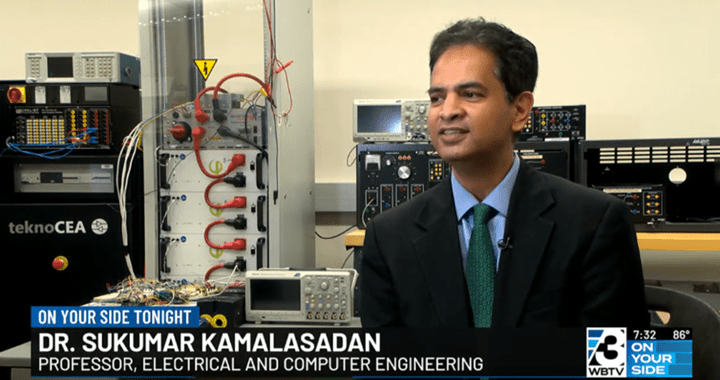
As technology advances at exponential rates, the need for computer engineers has never been greater. But what exactly does a computer engineer do?
Visit the Graduate School’s Application Requirements page to learn about general application requirements, deadlines, fees & waivers, transcripts, composing your statement of purpose, test scores and other application recommendations.
In addition to the established Graduate School admissions criteria, the Department of Electrical and Computer Engineering seeks the following from applicants to the Master’s program in Computer Engineering (MSCPE):
The GRE requirement will be waived for:
The MSCPE program requires successful completion of 30 graduate credit hours as approved by the student’s graduate advisor. At least 24 credit hours applied to the MSCPE degree must be from the Department of Electrical and Computer Engineering. This can be done using one of three options:
All options require students to complete the following:
Select from the following elective courses to complete the degree requirements. Courses not included in this list, including new and special topics courses on computer engineering, may be eligible with approval from the student’s graduate advisor. Also, online courses offered through the NCSU Engineering Online program would be eligible.
Note(s):
Students pursuing an optional concentration will replace 12 credits of electives with the concentration requirements.
A maximum of 6 credit hours of transfer credit, including courses taken through NCSU Engineering Online, are permitted.)
The Department of Electrical and Computer Engineering offers a Concentration in Artificial Intelligence and Machine Learning (AI and ML) for the MSCPE program. The concentration requires taking one core course and three courses from a list of approved electives. The Concentration in AI and ML empowers students to design intelligent and autonomous systems across various domains. It emphasizes the application of machine learning and data mining to solve real-world challenges and integrates intelligent behavior into computing platforms.
Machine Learning, a pivotal domain influencing numerous industries, is a key focus of this concentration. Students will acquire the expertise to choose, modify, optimize, or create machine learning algorithms tailored for specific applications. They will also learn to evaluate their efficacy, familiarize themselves with related software and hardware tools, manage and visualize diverse data sets, and interpret methods from the machine learning literature. With the knowledge from the Concentration in AI and ML, students are positioned for success in fields like data mining, robotics, natural language processing, and computer vision.
This concentration delves into topics such as computer vision, natural language processing, robotics, deep learning, and knowledge acquisition. Courses emphasize real-world machine learning applications in engineering systems, offering students a deeper understanding of practical machine learning deployment. Specific focus areas include anomaly detection, defect detection, predictive maintenance, intelligent scheduling, and resource allocation. Additionally, the concentration highlights the application of machine learning and advanced language models to real-world engineering tasks like reasoning, design, validation, and testing. Emerging trends in machine learning, such as generative AI and large pre-trained transformers, which promise to revolutionize future engineering systems, are also covered. The curriculum ranges from foundational subjects to more advanced, application-centric topics within broader engineering systems.
The concentration is reflected in the student’s transcript upon successful completion of the MSCPE program. Students interested in earning their MSCPE degree with the concentration must indicate their interest in this option in their Plan of Study which must be submitted within their second semester into the master’s program. The MSCPE degree can also be earned without specifying a concentration, where the student has greater flexibility in selecting their courses.
In order to earn a MSCPE degree with a Concentration in AI and ML, a student must take:
In addition to the requirements above, students seeking a graduate concentration must also complete the general requirements for the MSCPE degree for their chosen option (thesis, project, or course-only exam option). It is noted that the concentration courses may be used to fulfill the MSCPE degree requirements.
Current tuition rates are available through Niner Central. There are several sources of funding available to assist in paying for a graduate program at UNC Charlotte.
Use our Cost Calculator to get a clear picture of the estimated costs for UNC Charlotte’s graduate programs. Share your information to receive tips, updates, and resources on making your graduate education more affordable.
Wondering if you are considered in-state or out-of-state for tuition? Learn more about residency requirements.
Develop advanced skills in both hardware and software — core to today’s digital infrastructure. Computer engineers are in high demand, and the MSCE gives you the expertise to thrive in an evolving, tech-driven economy.







Specialize in the rapidly evolving world of AI with this optional concentration. You’ll gain the skills to build smarter technologies and prepare for roles like machine learning engineer, data scientist or AI researcher in fields that move fast — and shape the future.
See how Charlotte faculty and students are leading research that drives innovation, sparks collaboration and moves the field of computing forward.

Have questions about the program? Want to learn more about the application process or curriculum? Reach out. We’re here to help you move forward with confidence.
Check out the official catalog for information on specific degree requirements, course progressions, curriculum and more.